150 Years of Saint Matthews
Saint Matthew’s Lutheran Church was chartered in 1876, although the first Lutheran service in Kings Mountain was May 30, 1875. The congregation was organized by a group of young Lutherans who came to the White Plains area (now Kings Mountain) from the Dutch Fork community and from St. Mark’s Church in Gaston County.
History
A decade after the end of the Civil War the idea for St. Matthew’s Evangelical Lutheran Church was born in the hearts of a small group of young settlers who left their home church, St. Mark’s Lutheran, in the Dutch Fork community of Gaston County. Following the completion of the railroad from Washington to Atlanta in 1872 they came to Kings Mountain to raise their families and establish their businesses.
Two years after the City of Kings Mountain was established in 1874, they held the first Lutheran service in Cleveland County on May 30, 1875, in a small frame schoolhouse on the corner of King Street and Piedmont Avenue. St. Matthew’s was chartered and named in 1876 under the leadership of The Rev. J. R. Peterson who became its first pastor.
The ten founding members were Philip Baker, Marcus Carpenter, Anderson Carpenter, J. S. and Juletta Mauney, W. A. and Susan Mauney, L.A. and Catherine McAlister, and Margaret Carpenter Mauney. The cornerstone of the first church at the present-day location on the corner of Piedmont and Ridge was laid on September 7, 1878, and worshipers held services during the construction phase at the Academy on the site of what was to become Central School. The dedication of the new church was held in 1879 and the congregation’s first constitution was adopted in 1880.
Following the longest pastorate in the church’s history, that of The Rev. Dr. L. A. Bikle who served for 20 years from 1884 until 1904, the church was remodeled and the chancel, vestry room, and Sunday School auditorium were added and the pipe organ was installed.
The Rev. Dr. C. K. Bell followed as the next pastor in 1905. In 1908, two years before the Boy Scouts of America organization was officially chartered in the United States in 1910 by Lord Robert Baden-Powell of England, Dr. Bell received a charter from Lord Baden-Powell and established Troop 2 at St. Matthew’s as one of the earliest Boy Scout troops in the country. The first scoutmaster was Aubrey Mauney. The troop was later renamed Troop 91 and under the spirited leadership of Otis Falls over 100 boys were members in the late 1950s and early 1960s, making it one of the largest troops in the Southeast. Other hallmarks of Dr. Bell’s pastorate include the use of electricity, clerical vestments, and offering envelopes, as well as the formation of the Women’s Missionary Society and the Luther League.
The pastorate of The Rev. H. B. Schaeffer beginning in 1919 saw unprecedented growth of the congregation as the result of an extensive evangelistic effort reaching out to Lutherans and non-Lutherans alike. The large numbers attending Sunday School prompted the construction of the new Sunday School parish building in 1921 at a cost of $20,000 and the gift of a Sunday School bus by W. A. Mauney in 1922. The Convention of the NC Synod was held at St. Matthew’s on November 14, 1922. Pastor Schaeffer and the pastor of St. John’s Lutheran Church, Cherryville, joined forces along with their two congregations to form Ascension Lutheran Church, Shelby, whose first service was held on Palm Sunday 1923. The members of St. Matthew’s supported Ascension through financial pledges for the first ten years until their membership was strong enough to support itself.
The year 1935 marked the addition of choir vestments to enhance the worship service. An annex to the parish building was added in 1939, and in 1948 the nearby parish of St. Luke’s Lutheran Church merged with St. Matthew’s. In 1951 The Rev. Dr. William P. Gerberding became St. Matthew’s pastor.
The new parsonage was dedicated that same year and the new church where members still worship every Sunday morning was dedicated in November 1954.
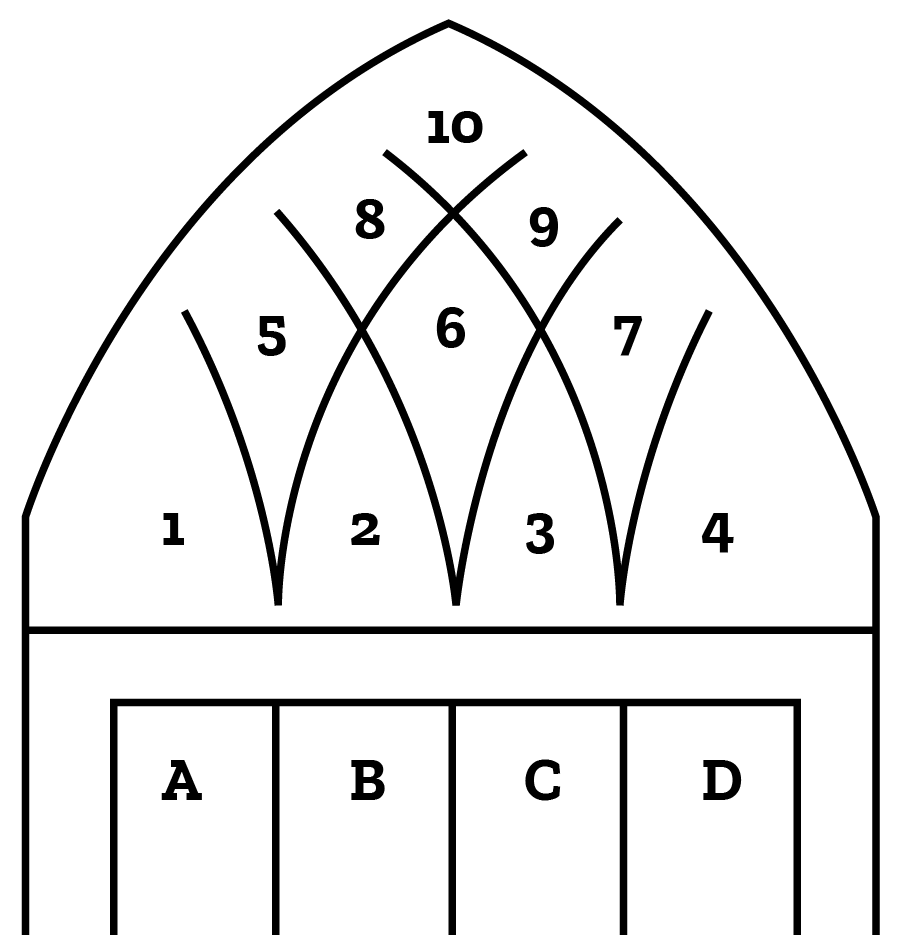
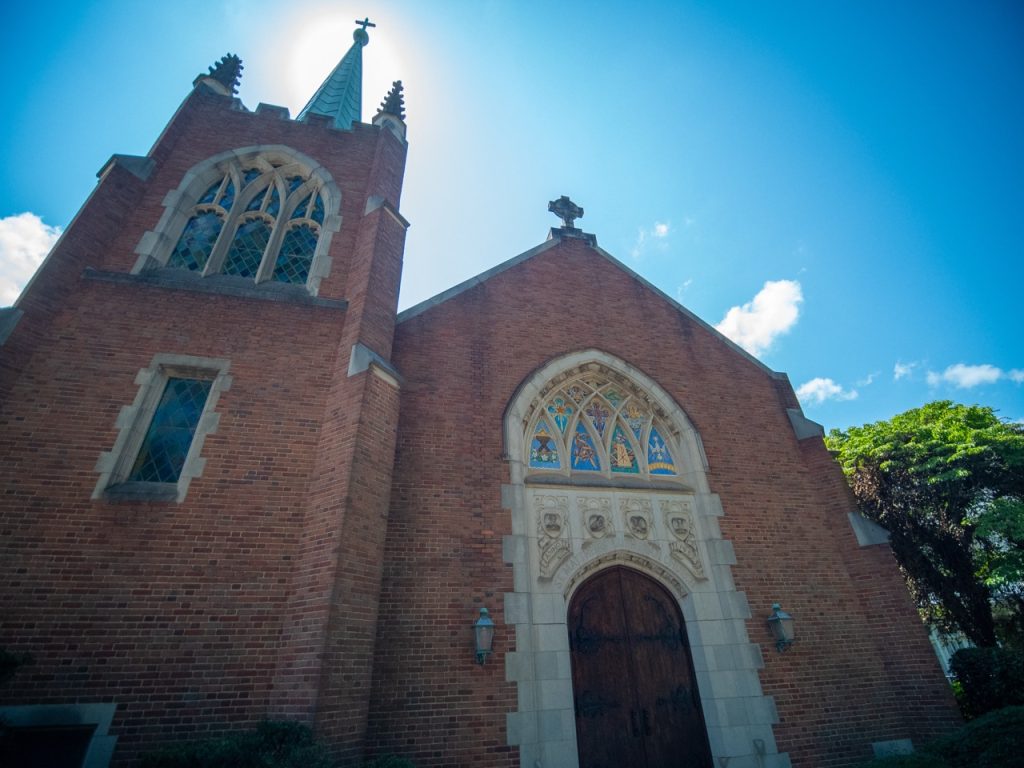
It was under the direction of architect Jens Frederick Larson that the new church building took shape in modified Gothic design with Swedish influence. The construction is of Old Virginia brick, adorned with Indiana limestone inside and out. The front entrance features two massive wooden doors with hand-wrought iron hinges. Above the doors are symbols of the four Evangelists (Matthew, Mark, Luke, and John) carved in stone. Above them is an exquisite Italian mosaic depicting nine seasons of the church year.
Inside the nave majestic pillars and arches form a small chapel for each of ten pairs of stained glass windows. The windows are made from hand-blown German glass to admit a maximum of sunlight which is reflected on the limestone walls. There are ten Old Testament saints on the north wall, six New Testament and four post-biblical saints on the south wall, each window being crowned with Luther’s Seal as is the entrance to the church. The oldest window in the church is found in the south narthex. Known as the Ascension window, it is from the original church building and depicts Christ’s ascending into heaven 40 days after Easter. In the main narthex is found a wood carving of Saint Matthew for whom the church was named.
The focal point of the worship area is the large brass altar cross behind which is located a richly-colored rendering of Jesus as the Good Shepherd. The altar, pulpit, and lectern were hand-carved in England, with the wood for the soaring eagle of the lectern coming from the Black Forest of Germany. These chancel furnishings crossed the Atlantic Ocean five times due to a longshoremen strike at New York Harbor which caused the ship carrying the wood pieces to be returned to England twice. At the foot of the chancel steps is the limestone baptismal font crowned with a descending dove on the silver lid.
In 1973 St. Matthew’s Pre-School opened its doors to students under the visionary leadership of The Rev. Robert E. Allen. The Pre-School has the distinction of being state-licensed and the longest continuously running program of its type in the area, having graduated well over 1,000 students.
During the tenure of The Rev. Harwood T. Smith, Jr., the Benevolent Foundation was formed in 1985 to provide a vehicle for devoted church members who have experienced the joy of giving and serving St. Matthew’s to be a permanent part of the life and future of their church. Additionally, a church van was bought through a matching funds campaign begun with seed money from an anonymous member donor and the remaining funds were used to establish a Lenoir-Rhyne Scholarship which has grown in recent years to include scholarships to St. Matthew’s Pre-School, Lutheridge, and the Agape/Kure Beach Ministries Day Camp.
Tragedy struck in the early morning hours of Christmas 1999 as parishioners learned that their beloved church was ablaze. The upstairs auditorium and downstairs fellowship hall were heavily damaged but gratefully no flames reached the sanctuary which was closed off for renovations including the addition of a slate floor given by members Martha and Glee Bridges to complement the beauty of the original architecture. The damaged areas were restored with the fellowship hall being moved upstairs and a reception area added downstairs. The Pre-School benefited from updates such as additional exits for safety and the addition of its own kitchen.
St. Matthew’s has enjoyed a strong and supportive relationship with the NC Synod over the years. Under the leadership of Dr. Bell in the early 1900s the St. Matthew’s Brotherhood was formed, the first of its kind in the state. Under the next pastor, Dr. Schaeffer, our men organized a District Brotherhood. From this movement grew our State, or Synodical, Brotherhood. The original ten men from St. Matthew’s took the lead in launching the Loan and Gift Fund by pledging $10,000 and this, combined with the state organization, was instrumental in the advancement of mission work in the NC Synod. The giving spirit of St. Matthew’s members continued over the years and in 1988 through the generous gift of brothers James E. Herndon, Jr. and William M. Herndon the concept of the Herndon Chapel at the NC Synod in Salisbury was formed with the chapel’s dedication following in 1991. The organ which fills the chapel with music was bequeathed by The Rev. James L. Dougherty whose last full-time parish was St. Matthew’s, culminating with the placement of the organ in its present home in the chapel in 2006.
Music from the bells of several carillons at St. Matthew’s have graced the neighborhood and downtown area over the years with the current one being given as a memorial gift in 2006. The bells chime the hour beginning at 9 a.m. and three hymns are played four times a day at 9 a.m., 12 noon, 3 p.m., and 6 p.m.
In December 2012 the congregation was gifted with the 1.1 acre lot across East Ridge Street from the church through the benevolence of James E. Herndon, Jr., a son of the congregation.
Architectural History
The first pastor, The Reverend J. R. Peterson, helped these charter members establish Saint Matthew’s:
- Philip S. Baker
- Marcus M. Carpenter
- Anderson P. Carpenter
- Mr. and Mrs. W. A. Mauney (Susan Ramseur)
- Mr. and Mrs. J. S. Mauney (Juletta Rudisill)
- Mr. and Mrs. L. A. McAlister (Catherine)
- Margaret S. Carpenter Mauney (Mrs. W. Sylvanus)
Sixteen pastors and several interim pastors have led the congregation in its spiritual growth in its one hundred-twenty years. During the pastorate of Dr. William P. Gerberding, the present church building was designed and constructed. His knowledge and contacts made it possible for Saint Matthew’s to have available some of the best minds in the field of church architecture. The present building was completed and dedicated in November 1954.
Architect
Jens Frederick Larson, Reynolda, N.C.
Pews
Southern Desk Company, Hickory, N.C.
Windows, Lights, Mosaic, & Chancel Furniture
George L: Payne, Paterson, N.J.
Outside Railing
Southern Engineering, Charlotte, N.C.
Wrought Iron
L. A. Freund, New York, N.Y.
Pipe Organ
M. P. Moller, Hagerstown, Md.
Bells
Schulmerich Carillons, Sellersville, Pa.
The Front Entrance
Above the massive doors with heavy hand wrought iron hinges are symbols of the four Evangelists carved in stone:
A. MATTHEW - His gospel points to Jesus as a true man; his symbol is a man with wings of gold.
B. MARK - The Lion, symbolizing the strength of Jesus as emphasized in Mark's gospel .
C. LUKE - Symbolized by the "Winged Ox" - Luke's full account of the sacrificial death of Christ suggests the animal most used for sacrifice.
D. JOHN - Because of the sublime height to which his writings soar, his symbol is the Eagle.
The Italian mosaic wall above the entrance depicts nine seasons of the church year.
The four major festivals are on the lower row:
1. Christmas ~ manger or crib
2. Lent - scourges or whips
3. Easter - open and empty tomb
4. Pentecost - the descending dove
Above them are:
5. Epiphany - the star
6. Good Friday - the cross
7. Ascension - the flaming chariot of Elijah
8. Presentation in the Temple - the Baptismal Font
9. Holy Trinity- three fish: an ancient symbol of the Savior
10. Luther's coat of arms - A cross on a heart, resting on the center of the Messianic rose and surrounded by a circle to symbolize eternity.